
How Survivorship Bias Can Derail Your Business Exit—and Your Retirement
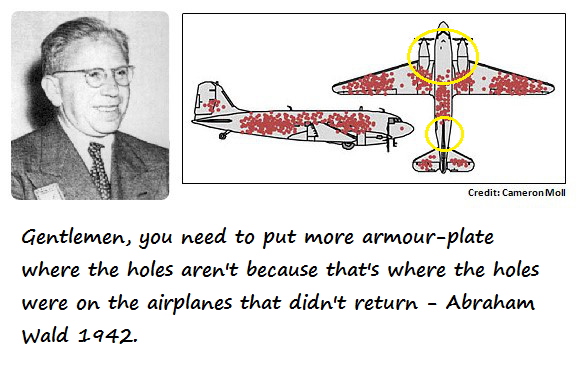
In 1943, the U.S. Air Force asked Columbia University a critical question:
How do we reinforce Allied bombers to reduce casualties without sacrificing performance?
The data looked straightforward. Bombers returned from missions riddled with bullet holes—clear evidence, it seemed, of where aircraft needed reinforcement.
But statistician Abraham Wald saw the flaw.
The planes being analyzed were the ones that survived. The bullet‑scarred sections weren’t the weak points—they were the areas a bomber could take damage and still make it home. The real vulnerabilities were the untouched areas. Damage there meant the aircraft never returned.
This insight became the classic definition of survivorship bias:
the mistake of drawing conclusions from what survives while ignoring what doesn’t.
And today, survivorship bias shows up everywhere—especially among successful business owners preparing for retirement.
“I’ve Survived Worse…”—Why Many Owners Miss the Real Risk
When I begin working with a new client, I often hear:
“Kyle, I made it through the dot‑com bust… 2008… COVID. I’m not worried about the business. I just want to know if I can retire.”
It’s well‑intentioned. It’s honest.
But it’s also a subtle form of survivorship bias.
Owners prefer to talk about familiar retirement topics:
- Investment income
- Tax planning
- Travel
- Medicare and Social Security
All important—but incomplete.
Because unlike traditional retirees, business owners face an additional, make‑or‑break step:
You must not only retire…
you must successfully sell your business.
And for most owners, the sale determines whether retirement is secure—or not.
Where Survivorship Bias Becomes Dangerous
Entrepreneurs often assume:
“If my business survived recessions, competition, and decades of pressure, it will survive the exit process too.”
But startup survival and exit success are two totally different games.
Business Survival Rates (Commerce Institute)
- 20% fail in year one
- 50% fail within five years
- 65% fail within ten
If you’re reading this, you’re in the successful minority.
But here’s the reframe:
What got you here isn’t what gets you out.
Exit Failure Rates (Exit Planning Institute)
- Only 20% of businesses listed for sale actually sell
- 80% never transact at all
So statistically speaking, selling a business is harder than surviving one.
And the challenge is growing.
The Silver Tsunami: A Supply-and-Demand Problem
We’re entering what researchers call the Silver Tsunami—a massive wave of baby boomer owners trying to exit at the same time.
According to Project Equity:
- Over 50% of privately held businesses have owners age 55+
- The majority have no succession plan
- Many struggle to find qualified buyers
More sellers. Fewer buyers.
Retirements delayed. Valuations pressured.
And many owners discovering too late that their “retirement plan” was really just a hope.
How to Avoid Becoming a Statistic
The first step is simple—and uncomfortable:
1. Set ego aside.
Not because you haven’t earned confidence.
You have. You survived the impossible.
But the exit deserves the same grit, intensity, and strategic focus you used to grow the business.
Most businesses don’t fail to sell because owners lack intelligence or drive.
They fail because owners assume survival so far guarantees survival through the sale.
Statistically… it doesn’t.
2. Treat the exit as its own separate business challenge.
A successful sale requires intentional preparation:
- Clean financials
- Transferable systems
- Reduced owner dependency
- Strategic tax planning
- Buyer‑ready documentation
- Realistic valuation
- Timeline planning
This isn’t retirement planning.
This is business transformation.
3. Ask the right question.
If you’re within 5–10 years of stepping away, the question is no longer:
“Have I done well so far?”
It’s: “What could prevent me from finishing well?”
That is the question that eliminates survivorship bias—and protects your retirement.
Finishing Well Doesn’t Happen by Accident
If you’re a business owner beginning to think about your exit, I encourage you to visit our website and schedule a short call. You don’t need a full plan today. You just need to start the conversation.
Because after decades of work, sacrifice, and survival—
you deserve to finish well.
